Ultra Fast Shred Stream
Every other feed on this chain, ours included, waits for a block to execute: a node runs the transactions, writes the result, and a feed hands it on. Ultra Fast Shred Stream does not wait. It reads the transactions straight from the shreds, the moment they arrive, and sends you each pump.fun and PumpSwap transaction before the block has run.
What shreds are
A Solana block is not sent around as one piece. The leader cuts it into small packets called shreds and sends those out as it builds the block, so the rest of the network receives the block while it is still being made. Put enough shreds together and you have the transactions in the block, as the leader ordered them, before any node has executed them. That is what this feed listens to. It is the earliest point at which a transaction can be seen by anyone who is not the leader.
Why it carries less than the Advanced Data Stream
The Advanced Data Stream describes what a transaction did: the price it got, the tokens it received, the fees it paid, the reserves it left behind. None of that exists yet when a shred arrives, because nothing has executed. Ultra Fast Shred Stream tells you what a transaction asks for: who sends it, which coin, buy or sell, the amount it puts in and the limit it sets on what comes out. It reads that from pump.fun's and PumpSwap's own instructions and, when a router or a bot calls them from inside, from that program's instruction. It is sent earlier, so it knows less. That is the trade, and it is the whole point: the launch and the intent are what a bot acts on, the result is what it accounts with.
wss://sol.shrine.trade/api/ultrafast/stream?key=…
What you get earlier
- A launch, with its mint. A pump.fun
createnames the mint, the bonding curve, the creator, the name, the symbol and the metadata URI in the instruction itself. You hold the mint before the block exists, and a Lightspeed buy can leave the same instant. A launch through a bot's or a launch site's own program arrives as acreatetoo. - Every buy and sell as sent. The trader, the coin, the side, the amount going in and the limit on what comes out. On PumpSwap, the pool and the quote mint too.
- Trades through routers and bots, with their side. Seven in ten pump.fun transactions call it through another program. The side is read from that program's own instruction for more than 60 routers, aggregators and bots, and the amounts where its data states them: see routed trades.
- Every hop of a route. A swap that goes through several pools and curves in one transaction arrives as one trade per pool or curve.
- The fee and the tip. Every launch and trade carries the compute-unit price and limit its transaction sets, the priority fee they come to and the SOL it tips: see fee and tip.
- The other launchpads and pools, when you ask. Raydium LaunchLab, Meteora DBC, DAMM v2, DAMM v1 and DLMM, Raydium CPMM, AMM v4 and CLMM, Orca Whirlpool: see other venues.
- The expected fill. On a pump.fun curve, a PumpSwap pool or a Raydium AMM v4 pool, what the trade would get at the pool's last executed state: see expected fill.
- Reverts included. A transaction that will fail is still a transaction the leader is about to run; it is on this feed, and never on an executed feed. Ask for statuses and each one is followed by whether it went through, a few milliseconds after it executes.
What it cannot carry
Nothing that only exists after execution: the SOL actually paid, the tokens actually received, reserves after the trade, fees, logs or balances. Nor what a program settles only when it runs: what the later hops of a route produce, or the direction of the few bots that choose it on chain. A tip paid from inside another program, rather than by the transaction's own transfer, is not seen. Only launches and trades are sent: pool creations, migrations, liquidity and fee claims are not. Whether it succeeded comes as a status when you ask for it; the Advanced Data Stream has all the rest a few milliseconds later. Run both: Ultra Fast Shred Stream to act, the executed stream to account.
How far ahead
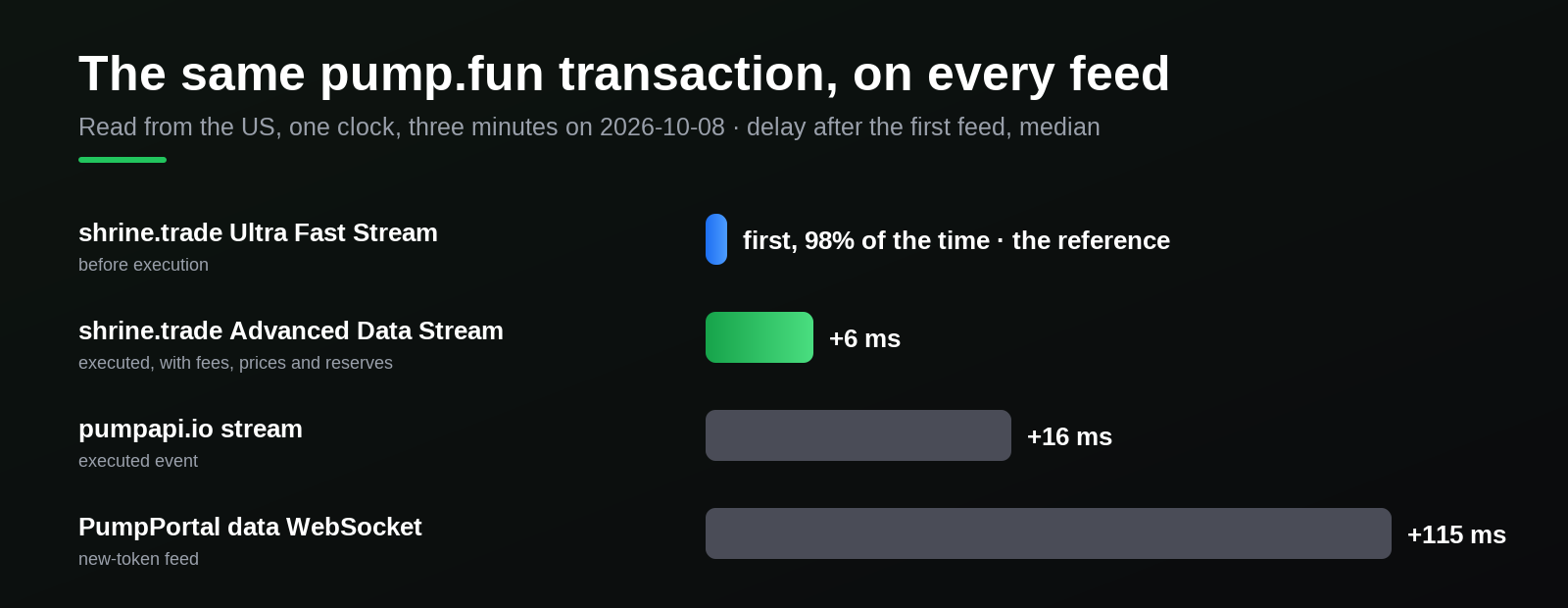
Measured on one machine in the US against the same transactions on 2026-10-08, over the public sockets, Ultra Fast Shred Stream on the New York region had each pump.fun transaction first on 98% of them: 6 ms before our own Advanced Data Stream in the same region, 16 ms before pumpapi.io, which serves every client from Frankfurt, and about 115 ms before PumpPortal's new-token feed. The gain is small against the best executed feed and large against everything else; what it buys is the whole order of events, not a fixed head start.
Key
Ultra Fast Shred Stream comes with the Developer and Professional plans: up to 2 sockets per key on Developer, 5 on Professional. Pass your plan's key as ?key= or in the x-api-key header.
A key without Developer or Professional is refused before the upgrade: 401 for a missing or unknown key, 403 plan_required for one on another plan, 429 limit_exceeded with all of its plan's sockets already open on the key.
The stream
wss://sol.shrine.trade/api/ultrafast/stream?key=…[&mints=…][&wallets=…][&creates=1][&all=1][&status=1][&protocols=…]
A plain WebSocket, JSON text frames. Say what you want in the query string, or change it with messages afterwards; subscribed confirms each change. On a private link the address is ws://<private address>:8110/api/ultrafast/stream?key=…: no TLS and no proxy in between, the same key and messages.
const ws = new WebSocket("wss://sol.shrine.trade/api/ultrafast/stream?key=…&creates=1");
ws.onmessage = (m) => {
  const e = JSON.parse(m.data);
  if (e.type === "create") {
    console.log("launch", e.symbol, e.mint);            // the mint, before the block exists
    ws.send(JSON.stringify({ subscribe: [e.mint] }));   // and follow its trades
  }
  if (e.type === "trade") console.log(e.side, e.mint, e.solAmount, "SOL", e.trader);
};
Subscriptions
| Query | Message | |
|---|---|---|
mints=…,… | {"subscribe": [...]}, {"unsubscribe": [...]} | Launches and trades of these mints (up to 500). |
wallets=…,… | {"subscribeWallets": [...]}, {"unsubscribeWallets": [...]} | Launches and trades whose trader is one of these wallets (up to 500): everything they do on the protocols you follow. |
creates=1 | {"creates": true} | Every launch, direct or through another program. Off by default. |
all=1 | {"all": true} | The whole tape: every launch and every trade. |
status=1 | {"status": true} | After each transaction you were sent, its status once it executes. Off by default. |
protocols=…,… | {"protocols": [...]} | The protocols every subscription above covers. PUMPFUN and PUMPSWAP by default; all for every one. |
{"ping": true} | Answered with {"type": "pong"}. |
In the query string a switch is on with 1, true or yes; in a message, false turns it off. One message can carry several changes, such as {"subscribe": ["…pump"], "status": true}. Every message but a ping is answered with subscribed and the whole filter as it now stands:
{ "type": "subscribed", "mints": ["…pump"], "wallets": [], "creates": true, "all": false, "status": true, "protocols": ["PUMPFUN", "PUMPSWAP"] }
Without protocols a socket gets pump.fun and PumpSwap only, as it always has: mints, wallets, launches and the whole tape alike. Name the others to add them (protocols=PUMPFUN,PUMPSWAP,BONK,METEORA_DBC), or take every one with protocols=all (in a message also "all", null or []). The names are the Advanced Data Stream's; an unknown one is refused, with a 400 on connecting or an error in reply to a message.
More than 500 mints or 500 wallets on one socket is answered with an error instead. connected comes once, first, with the newest slot the feed has seen and the subscriptions in force under filter, in the same form.
Events
Three messages carry data: create, trade and, when you ask for it, status. Every create and trade carries:
| Field | |
|---|---|
type | create or trade. |
protocol | PUMPFUN for a bonding curve, PUMPSWAP for a pool; the other venues' names below. |
preExecution | Always true. |
signature | The transaction's signature. |
slot | The slot whose shreds carried it: the block it lands in, if it lands. |
recv | Wall clock in ms when it came off the feed. |
mint | The coin. |
trader | The wallet. On a direct call, the user the instruction names; on a routed trade, the fee payer. |
leg | Its place among the transaction's messages (0, 1, …), so two legs of one transaction with the same amounts stay apart. |
computeUnitPrice, computeUnitLimit, priorityFeeLamports, tipLamports | What the transaction pays to be included: see fee and tip. |
A transaction's messages go out together, in leg order: its direct pump.fun and PumpSwap calls first, then the trades read through other programs. Amounts are integers in each mint's smallest unit: tokenAmount in the coin's (6 decimals on a pump coin), solLamports in lamports, quoteLamports in the quote mint's (lamports for SOL, millionths for USDC, a coin's own units for a coin). solAmount is solLamports in SOL.
create
{
  "type": "create", "protocol": "PUMPFUN", "preExecution": true,
  "signature": "3nQ…", "slot": 447483508, "recv": 1791325200123,
  "mint": "…pump", "trader": "…",
  "name": "…", "symbol": "…", "uri": "https://…",
  "bondingCurve": "…", "creator": "…", "createV2": true,
  "leg": 0
}
| Field | |
|---|---|
name, symbol, uri | As the create instruction gives them. uri is the metadata link. |
bondingCurve | The coin's bonding curve. |
creator | The creator the coin records, the wallet its creator fees go to. A launch service may sign the create for someone else, so it is not always trader. |
createV2 | true on a launch through the newer create instruction; absent on the older one. |
launchpad | PUMPFUN, as on the Advanced Data Stream. |
mayhem | true on a Mayhem mode launch; absent otherwise. |
routed, router | On a launch through another program, below. |
The dev buy that usually follows in the same transaction arrives as a trade with "createBuy": true, right behind the create. It goes out before a subscribe you send in reply to the create can take effect: to see dev buys, take the whole tape (all=1) and pick the createBuy trades. A launch whose first buy goes through a router comes as the create followed by a routed trade of the same mint, without createBuy. A coin launched through another program's create-and-buy comes as a create too, with "routed": true and the router: the new mint signs the transaction, and name, symbol, uri and creator are read from the router's data (null when it does not carry them). Its buy follows as a routed trade.
trade
{
  "type": "trade", "protocol": "PUMPFUN", "preExecution": true,
  "signature": "5aP…", "slot": 447483509, "recv": 1791325200231,
  "mint": "…pump", "trader": "…",
  "side": "buy", "tokenAmount": 1250000000000, "solAmount": 0.5, "solLamports": 500000000,
  "createBuy": false, "leg": 0
}
| Field | On | |
|---|---|---|
side | every trade | buy or sell, of the coin. null on a routed trade whose side cannot be read. |
tokenAmount | every trade | The coin amount, below. |
solLamports, solAmount | curve trades, hops quoted in SOL | The SOL amount, below. |
createBuy | direct curve trades | true when the same transaction creates this coin: the dev buy. |
pool | PumpSwap trades | The pool. |
quoteMint, quoteLamports | PumpSwap trades, hops, routed curve trades not quoted in SOL | What the coin trades against, and that amount. |
bondingCurve | routed curve trades, curve hops | The coin's bonding curve. |
via | hops, buybacks | multi_hop on a hop of a route, boost_buy_and_burn on a pool's buyback. |
hop, hops, minAmountOut | hops | See multi-hop routes. |
routed, router | routed trades | See routed trades. |
launchpad | curve trades | PUMPFUN. |
mayhem | curve trades | true on a Mayhem coin's trade (the create in the same transaction, or one the stream saw). |
The amounts are what the instruction asks for, since nothing has executed: one is what goes in, the other a limit.
| Instruction | tokenAmount | SOL or quote amount |
|---|---|---|
a buy of a set number of tokens (buy, buy_v2, buy_v3) | the tokens asked for | the most the trader will pay |
a buy that spends a set amount (buy_exact_sol_in and the buy_exact_quote_in forms) | the least accepted | exactly what is spent |
| a sell, any version | exactly what is sold | the least accepted |
The message does not say which buy it is: on any buy, the SOL or quote amount is the most the trader pays and tokenAmount is a bound, not the fill. A PumpSwap trade carries pool, quoteMint, tokenAmount and quoteLamports in place of the SOL fields, read the same way. On the few pools opened with SOL or USDC as the base and the coin as the quote, the trade is still given from the coin's side (mint is the coin, quoteMint is SOL or USDC); there the limit sits on tokenAmount (the least received on a buy, the most sold on a sell) and quoteLamports is exact. The v3 curve trades (buy_v3, buy_exact_quote_in_v3, sell_v3) arrive like any other pump.fun trade; a v3 buy that empties the curve keeps buying from the tokens the migration deposits, so its executed total can be more than the curve had left. On a curve quoted in USDC or another token instead of SOL, a direct curve trade still puts its quote amount in solLamports, in that quote's smallest unit (so solAmount is not SOL there), and does not name the quote; a routed one names it in quoteMint. PumpSwap's boost_buy_and_burn, a buy by a pool's buyback authority whose tokens are then burned, arrives as a PumpSwap buy with "via": "boost_buy_and_burn": quoteLamports is spent, tokenAmount is the least received, and trader is the authority.
Multi-hop routes
A PumpSwap multi_hop_swap trades through several pools and curves in one instruction (a coin paired with another pump coin, bought with SOL). It arrives as one trade per hop, in route order:
{
  "type": "trade", "protocol": "PUMPFUN", "preExecution": true,
  "signature": "3b5…", "slot": 454824976, "recv": 1791538132004,
  "mint": "3Tdp…Mpump", "trader": "…",
  "side": "buy", "via": "multi_hop", "hop": 1, "hops": 2,
  "bondingCurve": "…", "quoteMint": "56Zt…fpump",
  "tokenAmount": null, "quoteLamports": null, "minAmountOut": 1,
  "leg": 1
}
hop counts from 0 and hops is the route's length; protocol is PUMPSWAP for a pool hop (with pool) and PUMPFUN for a bonding curve hop (with bondingCurve); quoteMint is what the hop is paid in. Every hop of a route has the same side. Only the route's input is known before execution: on a buy route the first hop carries quoteLamports (and solLamports and solAmount when that quote is SOL), on a sell route the first hop carries tokenAmount; every other amount is what the previous hop produces and is null. minAmountOut is the least the whole route must produce, in what it ends with, on the last hop (null on the others). Filter by mint to receive the hop for your coin.
Routed trades
Seven in ten pump.fun transactions do not call the program directly: a router, an aggregator or a bot's own program calls it from inside. Before execution there is no inner instruction to read, so the stream reads the calling program's own instruction instead: the accounts it hands over and its data. Such a trade is marked "routed": true with the router, the first program the transaction calls other than pump.fun, PumpSwap and Solana's own programs:
{
  "type": "trade", "protocol": "PUMPFUN", "preExecution": true,
  "signature": "3F9…", "slot": 455047120, "recv": 1791623412044,
  "mint": "…pump", "trader": "…",
  "routed": true, "router": "FLASHX8DrLbgeR8FcfNV1F5krxYcYMUdBkrP1EPBtxB9",
  "bondingCurve": "…",
  "side": "buy", "tokenAmount": 9065663670, "solAmount": 0.00099, "solLamports": 990000,
  "leg": 0
}
- The coin and the trader are always there. On a curve trade the mint is the coin whose bonding curve is in the transaction (with
bondingCurve); on a PumpSwap trade thepoolandquoteMintare read from the accounts the router hands to PumpSwap, with the pool's coin asmint. When the pool cannot be told,poolandquoteMintare left out and only the coin is known.traderis the fee payer. - The side is read from the router's own instruction for more than 60 routers, aggregators and bots: Jupiter's route plans, DFlow, OKX, FLASHX and the busiest trading bots' programs, by the step they name, the accounts they pass or the two ends of the route. On 148 fresh blocks of 2026-10-28, 98.6% of routed PumpSwap trades and 98.0% of routed curve trades came with their side, none with the wrong one.
sideisnullwhen the program decides the direction on chain, or is not one of those read. - The amounts come when the router's data states them for that trade. On a buy, the quote amount is what goes in and
tokenAmountthe least accepted (on a Jupiter route, its quoted output less its slippage); on a sell,tokenAmountis what is sold and the quote amount the least accepted. About one routed trade in seven passes pump.fun's own instruction through unchanged, and its amounts read as on a direct trade. An amount the program fills in only when it runs isnull, and so is one the data does not carry. - Several trades in one transaction each come as their own message, up to four: every pool or curve of a route a router hands to PumpSwap, the buy and the sell of an arbitrage cycle (the same pool twice, one message each way), two coins at once. Each carries its side; the amounts are usually
nullwhen there are several. A router that swaps SOL to USDC on PumpSwap and then buys a USDC-quoted coin on its curve sends one for each. - Next to direct calls. A transaction that calls pump.fun or PumpSwap directly and also through a router sends both: the direct trade as usual, the routed ones after it.
A routed curve trade on a coin quoted in something other than SOL names that quote in quoteMint, with its amount in quoteLamports instead of solLamports. A routed trade carries no createBuy, via, hop or hops. It is an intent with less detail, not a different kind of event: filter by mint or trader as for any other.
Accounts a transaction keeps in address lookup tables are read like any other: the shreds carry them resolved. Busy bots, and transactions where two wallets trade at once, nearly always use them.
Fee and tip
Every create and trade carries what its transaction pays to be included, read from the transaction's own instructions. All of a transaction's messages carry the same four.
| Field | |
|---|---|
computeUnitPrice | The price per compute unit it sets, in micro-lamports. 0 when it sets none. |
computeUnitLimit | The limit it sets; without one, Solana's default of 200,000 per instruction that is not a compute budget one, at most 1,400,000. |
priorityFeeLamports | Price times limit over 1,000,000, rounded up: the priority fee the chain charges, on top of the base fee. |
tipLamports | The SOL it sends to the tip accounts of Jito and the landing services, by its own transfers. 0 when none. |
Expected fill
On a direct trade on a pump.fun curve, a PumpSwap pool or a Raydium AMM v4 pool, expected says what the trade would get at the pool's state after its last executed trade:
"expected": { "tokenAmount": 3335302728944, "quoteAmount": 1000000000, "price": 2.998e-7, "priceImpactBps": 102, "feeBps": 125, "withinLimit": true, "slot": 447483507 }
| Field | |
|---|---|
tokenAmount, quoteAmount | The coin and the quote it would get or pay, fees included, in their smallest units. The amount the instruction fixes is the one asked for. |
price | quoteAmount over tokenAmount, in whole coins and whole quote. |
priceImpactBps | How far the pool's price moves against the trade, fees left out. |
feeBps | The fee rates the fill counts: on a curve and on PumpSwap, those the coin's or the pool's last trade paid (on a curve the standard 0.95% and 0.30% when they are not known); on AMM v4, 0.25%. |
withinLimit | Whether that fill meets the trade's own limit: the least it accepts, or the most it pays. false means it would fail at this state. |
slot | The slot of the trade that left the state used. |
It is the program's own integer math on the state after the last executed trade: trades ahead of this one in the same block are not in it, so the fill is what the trade gets if nothing lands before it. An AMM v4 pool is priced on swaps with the amount in exact, and only once its own last two trades have borne its state out (the first one's state moved by its amounts was the second's starting state, and the second paid out what 0.25% and the pool's reserves give). It is left out where the math cannot be done exactly: a buy that would empty the curve, a pool with the coin as its quote, a routed trade or a hop, a pool with no executed trade seen yet, and the other venues. LaunchLab and CPMM pools' fee rates are not on the executed stream (nor a LaunchLab curve's size, nor a CPMM pool's protocol and fund shares of each fee, which its next state depends on), and the concentrated-liquidity pools need more of their state than it carries.
Other venues
With protocols, the stream reads these venues too, before execution and in the same messages:
| Venue | protocol | How the amounts read |
|---|---|---|
| Raydium LaunchLab | BONK; STONKFUN on StonkFun's platform | buy_exact_in: quote in exact, least coin out. buy_exact_out: coin out exact, most quote in. The sells the same way round. |
| Meteora DBC | METEORA_DBC | swap: amount in exact, least out. swap2: the same, or amount out exact and most in when its mode is exact out. |
| Meteora DAMM v2 | METEORA | As DBC. |
| Meteora DAMM v1 | METEORA_DAMM_V1 | swap: amount in exact, least out. |
| Meteora DLMM | METEORA_DLMM | swap, swap2: amount in exact, least out. swap_exact_out: amount out exact, most in. swap_with_price_impact: amount in exact, no least out (null). |
| Raydium CPMM and AMM v4 | RAYDIUM | swap_base_input, SwapBaseIn: amount in exact, least out. swap_base_output, SwapBaseOut: amount out exact, most in. |
| Raydium CLMM | RAYDIUM_CLMM | swap, swap_v2: by is_base_input, amount in exact and least out, or amount out exact and most in. |
| Orca Whirlpool | ORCA | swap, swap_v2: the same, by amount_specified_is_input. two_hop_swap: one trade per whirlpool, as a route. |
A trade reads like a PumpSwap trade: pool, mint (the coin), quoteMint, the coin's side, tokenAmount and quoteLamports. exactIn says which amount is exact: true, the amount going in, the other the least out; false, the amount coming out, the other the most in. The coin is the base on LaunchLab and DBC; elsewhere it is the mint that is not SOL, USDC or USD1, as on the Advanced Data Stream. A pool of two of those, or of two other mints, comes with its pool and trader, and mint, side and the amounts null.
The direction is read where the instruction states it (LaunchLab's buy or sell, CPMM's input mint, the Whirlpool and CLMM flags), else from the user's token account it pays from: one the same transaction opens for a mint, or the owner's associated account. AMM v4, DAMM v1 and the first Whirlpool and CLMM swaps do not name their mints: those come from the pool's earlier trades, or from the accounts the transaction opens. What cannot be told is null, never guessed.
Launches on LaunchLab and DBC arrive as a create with mint, name, symbol, uri, creator, pool and quoteMint, and a buy in the same transaction carries "createBuy": true. launchpad names the site, as on the Advanced Data Stream: on LaunchLab, its protocol (BONK, STONKFUN); on DBC, when the pool's config, the config's creation or the launch shows it: BAGS, JUPITER_STUDIO, BELIEVE, MOONSHOT, TRENDS_FUN, ANONCOIN, VIRTUALS and a few smaller ones. Bags, Believe and Jupiter Studio make a config per coin or per creator, so their coins are named from a launch or a config the stream has seen.
Through a router, a swap on LaunchLab, DBC, DAMM v2, CPMM or AMM v4 is read from the accounts the router hands over: "routed": true with the router, the pool and its mints, the side from the venue's accounts or a Jupiter route's two ends, and no amounts. DLMM, CLMM and Whirlpool are read when called directly.
DLMM, Whirlpool and CLMM carry many times pump.fun's transactions, most of them arbitrage: all=1&protocols=all is a heavy socket. Follow a few mints or wallets on every venue, or take the whole tape of the launchpads (protocols=BONK,STONKFUN,METEORA_DBC).
status
With statuses on, every transaction you were sent is followed by one status once it has executed (at processed), after all of its other messages:
{ "type": "status", "signature": "5aP…", "slot": 447483509, "success": true, "recv": 1791325200234 }
{ "type": "status", "signature": "2kq…", "slot": 447483509, "success": false, "error": "InstructionError(2, Custom(6001))", "recv": 1791325200236 }
slot is the slot it executed in and recv the wall clock in ms when the execution was seen. error comes only on a failure: the transaction error as Solana prints it, the index of the instruction that failed and the program's error code (in the rare case it cannot be read, its raw bytes as hex, 0x…). A status goes to every socket with statuses on that was sent one of the transaction's messages: by its mint, its wallet, as a launch or with the whole tape. About half of the transactions on this feed fail. A transaction that never makes it into a block gets no status; one not heard of within 30 seconds did not land. The status comes from the executed side, so it arrives a few milliseconds after the trade, never before it.
Connection messages
{ "type": "connected", "slot": 447483507, "filter": { "type": "subscribed", "mints": [], "wallets": [], "creates": true, "all": false, "status": false, "protocols": ["PUMPFUN", "PUMPSWAP"] } }
connected comes first, once. subscribed answers every message but a ping, {"type": "pong"} a ping. {"type": "lagged", "dropped": n} means your client read too slowly and n events were skipped. {"type": "error", "message": …} answers a bad message: JSON that does not parse, or a filter over its limit. The feed reconnects on its own.
Pairing with Lightspeed
A create from this stream and a Lightspeed request with its mint is the shortest path from a launch to a landed buy that this API offers. The copy trade pattern is the same: follow a wallet here, mirror its buys there.
LimitsDeveloper 2 socketsProfessional 5 socketsSee plans →